Hamilton, Ontario EV Charging Stations Info
General EV Charging Information
Hamilton's public charging network has matured into one of the most accessible in Ontario's Golden Horseshoe, yet drivers still face real decisions about which network to use, where to charge near key destinations, and how to navigate EV charging in Hamilton without juggling multiple accounts. Whether you're a resident commuting between Ancaster and downtown, a visitor heading to the Art Gallery of Hamilton, or a road tripper passing through on the QEW corridor, understanding the local charging landscape makes every trip easier. This resource covers EV charging in Hamilton from a practical, street-level perspective — networks, neighborhoods, destinations, condo access, and the federal incentives that just returned in 2026.
Hamilton's Charging Networks: ChargePoint, FLO, Electrify Canada, and Tesla
EV charging in Hamilton runs across four major networks, each with a different pricing model and connector mix. Knowing the differences saves time and money.
| Network | Charging Level | Connector Types | Billing Model |
|---|---|---|---|
| ChargePoint | Level 2 (240V, adds 11–54 km/hour) & DCFC | J1772 (standard North American AC connector), CCS, NACS | Per-session or per-kWh |
| FLO | Level 2 & DCFC | J1772, CCS (Combined Charging System, standard DC fast-charging connector) | Per-hour or per-kWh |
| Electrify Canada | Level 3 (DC fast charging) only | CCS, CHAdeMO, NACS | Per-minute |
| Tesla Supercharger | Level 3 DCFC | NACS (North American Charging Standard, Tesla connector now industry-wide), CCS adapter available | Per-kWh |
Electrify Canada operates a prominent Level 3 station at the Canadian Tire location at 80 Main Street West, accessible 24 hours a day. Tesla's Supercharger station at 999 Upper Wentworth Street serves Tesla drivers and, with a CCS adapter, certain other EV models.
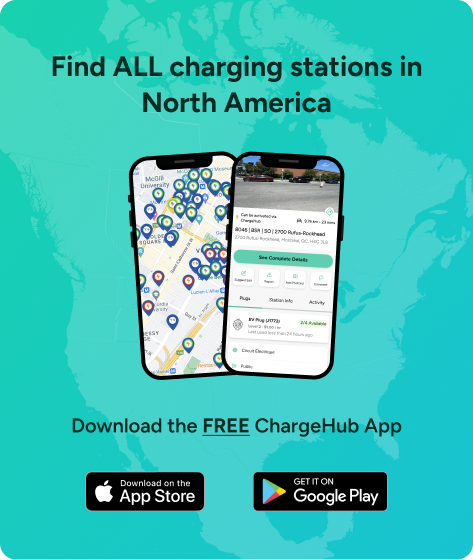
ChargePoint operates one of Canada's largest EV charging networks, with strong commercial and workplace coverage across Hamilton's business districts. FLO stations are accessible directly through the ChargeHub app, eliminating the need for a separate FLO account. All four networks are consolidated on the ChargeHub map, so you can check real-time availability across every network in one place.
Electrify Canada and Petro-Canada offer consistent pricing across the country, while FLO stations are privately owned and prices are set by the site hosts. This means FLO rates can vary by location. Always confirm current pricing through the ChargeHub app before you plug in.
Charging Across Hamilton's Neighborhoods: Downtown to Stoney Creek
EV charging in Hamilton is not evenly distributed across the city's geography. Coverage concentrates along the lower city core and major commercial corridors, with lighter density in certain suburban and mountain-top areas.
Downtown and the Lower City
The downtown core near Jackson Square and Hamilton City Hall has ChargePoint Level 2 charging ports in municipal parking facilities. The ChargePoint charging plugs at Hamilton City Hall are located on the upper level of Lot 40, accessed via the Hunter Street West entrance. This makes downtown errands and evening visits easy to pair with a charge.
Westdale, Kirkendall, and Crown Point
EV chargers in neighborhoods like Westdale and Crown Point support cleaner air and reduced reliance on fossil fuels. FLO Level 2 stations appear at institutional and commercial sites throughout these residential neighborhoods. Drivers in Kirkendall and Westdale can locate stations within a few blocks of major streets using the ChargeHub app.
Ancaster, Dundas, and Stoney Creek
From charming homes in Kirkendall to bustling hubs in Stoney Creek, Hamilton's EV charging infrastructure spans the city's diverse communities. Ancaster and Dundas have Level 2 public charging at retail plazas and municipal sites. Stoney Creek, along the Lake Ontario shoreline, benefits from proximity to the QEW corridor charging options. Use the ChargeHub mobile app to find charging stations in Hamilton near me in real time, including stations that may not appear in network-specific apps.
Destination Charging: Hotels, Attractions, and the John C. Munro Airport
Trip planning for EV charging in Hamilton is straightforward once you know which destinations offer on-site charging.
Hotels With EV Charging
Hotels in Hamilton with EV chargers include Homewood Suites by Hilton Hamilton and Staybridge Suites Hamilton Downtown. The Sheraton Hamilton Hotel is connected to the Hamilton Convention Centre and offers on-site dining and an indoor pool — and EV charging for guests. TownePlace Suites by Marriott Hamilton, located 5.9 km from the Art Gallery of Hamilton, offers free private parking with EV charging access.
Booking a hotel with on-site charging lets you arrive with a low battery and wake up fully charged, eliminating the need to find a public station during your stay.
Arts, Culture, and Attractions
Downtown Hamilton offers art, culture, and cuisine, with attractions including the Art Gallery of Hamilton, local breweries, waterfront walks, and access to more than 100 waterfalls in the surrounding region. ChargePoint and FLO stations are accessible near major cultural sites. Charging while you explore Albion Falls or the Hamilton waterfront is a practical way to combine sightseeing with a top-up.
John C. Munro Hamilton International Airport
The modern Hamilton hotel near John C. Munro Hamilton International Airport offers Italian dining and spacious accommodation with EV charging. Drivers flying in and out of Hamilton International can locate stations within a short drive of the terminal using the ChargeHub iPhone app or the ChargeHub Android app.
Condo and Apartment Charging in Hamilton's Multi-Unit Buildings
Clean Energy Canada reports that two-thirds of apartment-dwellers aged 18 to 44 in the Greater Toronto Hamilton Area say they're inclined to buy an EV. That demand is running ahead of charging access in certain multi-unit buildings, making public charging a critical resource for Hamilton renters and condo owners.
Ontario's "Right to Charge" Legislation
If you are a condo owner in Ontario, you have rights under the Condominium Act, 1998 (Ontario) to apply to install an EV charging station in your parking spot for your own use — also known as Ontario's "Right to Charge" legislation. Your condo board may only reject an application for limited reasons.
The process involves:
- Submit a written application to your condo board with drawings and specifications
- Wait for a response — once the condo owner submits all proper paperwork, the condo board has 60 days to formally respond to the application
- Negotiate a cost-sharing agreement if multiple owners want chargers at the same time
- Confirm electrical capacity — the addition of an EV charging station requires that your condo or apartment have electrical capacity and space in its existing circuit breakers
Apartment Renters
For apartment tenants, the path to getting an EV charger is less clear due to the fact that spaces are rented instead of owned. In most cases, large landlord companies have established corporate processes for tenants to request EV charging. Until building-level charging is available, Hamilton's extensive public charging network provides reliable access for apartment-dwelling EV drivers. A survey by the nonprofit Pollution Probe found that 42% of Canadian EV owners who live in apartments and condos rely on public charging for more than half their charging needs.
Federal EV Incentives for Hamilton Drivers in 2026
Ontario has not offered a provincial EV purchase rebate since 2018. For Ontario specifically, the federal incentive matters more than it might in provinces with extra rebates, because Ontario hasn't had a provincial EV purchase rebate since 2018 — making the federal incentive one of the biggest "instant discounts" available to Ontario buyers.
The federal Electric Vehicle Affordability Program (EVAP) launched on February 16, 2026. According to Transport Canada's official EVAP page:
- Incentives start at up to $5,000 for battery-electric and fuel cell electric vehicles, and up to $2,500 for plug-in hybrid vehicles
- The program covers vehicles with a final transaction price up to and including $50,000, with no price limit for Canadian-made EVs. Only EVs manufactured in Canada or in countries with which Canada has free-trade agreements are eligible.
- For battery-electric vehicles, the rebate is $5,000 in 2026, then $4,000 for 2027, $3,000 for 2028 and 2029, and $2,000 in 2030. PHEV purchasers receive $2,500 in 2026, $2,000 in 2027, $1,500 in 2028 and 2029, and $1,000 in 2030.
- EVAP is scheduled to conclude on March 31, 2031.
The incentive applies at the point of sale, so Hamilton-area buyers receive the discount immediately rather than waiting for a tax credit.
Public Charging Costs in Hamilton: What to Expect
Charging costs for EV charging in Hamilton vary by network, charging level, and membership status. Rates are subject to change and should always be confirmed through the ChargeHub app or the network's own platform before starting a session.
Ontario Energy Board and Time-of-Use Rates
In Hamilton, electricity rates are set by the Ontario Energy Board (OEB). Most residential customers are on a Time-of-Use (TOU) pricing plan, which divides the day into three periods: off-peak at approximately 8.7 cents per kilowatt-hour (kWh), mid-peak at approximately 12.2 cents per kWh, and on-peak at approximately 18.2 cents per kWh. These rates apply to residential consumption and inform the baseline cost of public charging.
Public Network Pricing
- Electrify Canada (Level 3 DCFC): As of the source date, guest and Pass Members paid approximately $0.27 per minute for 1–90 kW sessions, while Pass+ Members paid approximately $0.21 per minute, with a $4.00 monthly fee. Rates are per-minute and subject to change.
- FLO (Level 2): The FLO station at IBEW Local 105 offers Level 2 charging using a J1772 (standard North American AC charging connector) at approximately $1.50 per hour, though FLO rates vary by site host.
- ChargePoint: Billing is generally per-kWh or per-session; rates generally range from approximately $0.35–$0.45 per kWh at commercial locations, subject to change.
- Tesla Supercharger: Pricing for Tesla Superchargers varies and should be checked through the Tesla app for the most current rates.
Public Level 2 chargers typically cost approximately twice as much as residential energy, and DC fast chargers cost three times or more — but provide speed and convenience.
Practical Tips for EV Charging in Hamilton
- Use ChargeHub as your single charging tool: The ChargeHub map consolidates real-time availability, pricing, and payment across ChargePoint, FLO, Electrify Canada, Tesla, and every other major network in Hamilton — no need to check multiple platforms.
- Plan around the Electrify Canada station at Main Street West: The 24/7 Electrify Canada DCFC at 80 Main Street West is one of Hamilton's most accessible fast-charging locations for drivers who need a quick top-up in the lower city.
- Charge during off-peak hours when possible: For most EV owners, TOU pricing is generally more economical, especially if you can charge during off-peak hours. Off-peak periods run evenings and weekends for most Ontario residential customers.
- Book hotels with on-site charging for overnight trips: Properties like Homewood Suites by Hilton Hamilton and Staybridge Suites Hamilton Downtown offer EV charging, letting you arrive with a low battery and depart fully charged.
- Know your connector before you go: Hamilton stations support CCS, CHAdeMO (Japanese DC fast charging standard), J1772, and NACS connectors. The ChargeHub app filters by connector type so you only see compatible stations.
- Condo owners: invoke your "Right to Charge": Ontario's Condominium Act gives you the legal right to apply for a charging station in your parking spot. Your condo board has 60 days to respond and can only reject for specific technical reasons.
- Download the ChargeHub app before your trip: The ChargeHub iPhone app and ChargeHub Android app let you locate stations, check real-time availability, and pay across all networks from one account — eliminating range anxiety before you leave the driveway.
- Watch for idle fees at DCFC stations: At Electrify Canada stations, a fee of approximately $0.40 per minute applies after a 10-minute grace period once charging stops. Move your vehicle promptly to avoid extra charges and free up the station for other drivers.
- Confirm EVAP eligibility before purchasing: The federal EVAP rebate of up to $5,000 applies at point of sale for eligible vehicles with a final transaction price of $50,000 or less. Confirm the vehicle's build origin and final transaction value with your dealer before signing.
Frequently Asked Questions
Where can I find DC fast charging for EV charging in Hamilton?
The most accessible DC fast charging option is the Electrify Canada Level 3 station at the Canadian Tire location at 80 Main Street West, which operates 24 hours a day. Tesla's Supercharger station at 999 Upper Wentworth Street serves Tesla drivers and compatible vehicles. ChargePoint also operates DCFC (DC Fast Charging) stations at certain commercial locations across the city. Use the ChargeHub map to find all DCFC stations near you in real time, filtered by connector type.
What does EV charging in Hamilton typically cost at public stations?
Costs vary by network and charging level. Electrify Canada DCFC stations charge per-minute, with rates generally around $0.27 per minute for sessions up to 90 kW for guest users, as of the last published rate schedule — always confirm current pricing through the ChargeHub app before starting a session. FLO Level 2 stations typically charge approximately $1.50 per hour at certain Hamilton locations, though FLO rates are set by individual site hosts and vary. ChargePoint rates generally range from approximately $0.35–$0.45 per kWh at commercial sites. Tesla Supercharger pricing varies and should be confirmed through the ChargeHub app.
Is there a provincial rebate for buying an EV in Ontario in 2026?
Ontario does not offer a provincial EV purchase rebate as of early 2026. However, the federal Electric Vehicle Affordability Program (EVAP) launched on February 16, 2026, offering up to $5,000 for eligible battery-electric vehicles and up to $2,500 for eligible plug-in hybrid vehicles. The vehicle must have a final transaction price of $50,000 or less, with no price cap for Canadian-made EVs. The rebate applies at point of sale. Visit the Transport Canada EVAP page for the current list of eligible vehicles.
As a condo owner in Hamilton, can I get a charging station in my parking spot?
Yes. Ontario's "Right to Charge" legislation under the Condominium Act, 1998 gives condo owners the right to apply for an EV charging station in their own parking spot. Your condo board has 60 days to respond to a formal application and can only reject it for specific technical reasons, such as insufficient electrical capacity. Coordinating with neighbors to install multiple stations at once can reduce per-unit costs. Electric vehicle charging in Hamilton's multi-unit buildings is increasingly common as condo boards respond to growing resident demand.
How do I find Hamilton EV charging stations without downloading multiple network apps?
The ChargeHub app consolidates electric vehicle charging Hamilton coverage across all major networks — ChargePoint, FLO, Electrify Canada, Tesla, and others — into a single map with real-time availability and unified payment. You can filter by connector type, charging level, and network, and pay for sessions across different networks without creating separate accounts for each. Download the ChargeHub app for iPhone or Android to locate EV charging stations in Hamilton before your next trip.
Charging Stats For Hamilton

86%
of Level 2 Stations
247
total Level 2 Stations

14%
of Level 3 Stations
41
total Level 3 Stations
Percentage of Free Stations: 18%
Total Number of Free Stations: 52
Total Number of Charging Stations: 288
Main Networks: None, ChargePoint, Tesla